A platform and service that takes organisations through discovery, assessment, testing and proof of post-quantum cryptography, covering four banking-system use cases.
Key Features
- Cryptographic discovery: read-only scan of endpoints, source code and key stores
- Quantum exposure assessment on a digital twin, ranked by how long data must stay secret
- ML-KEM, ML-DSA and hybrid key exchange tested side by side with today's setup
- Graded report, CycloneDX CBOM and a validation record with every limit stated
Quantum computers will break the public-key cryptography that protects banking, telecom, defence and medical systems today. The replacements are standardised, but they are larger and slower in places, and they touch every system that uses encryption. We show you where you are exposed, what changes when you switch, and what it costs, before anything in production moves.
The challenge
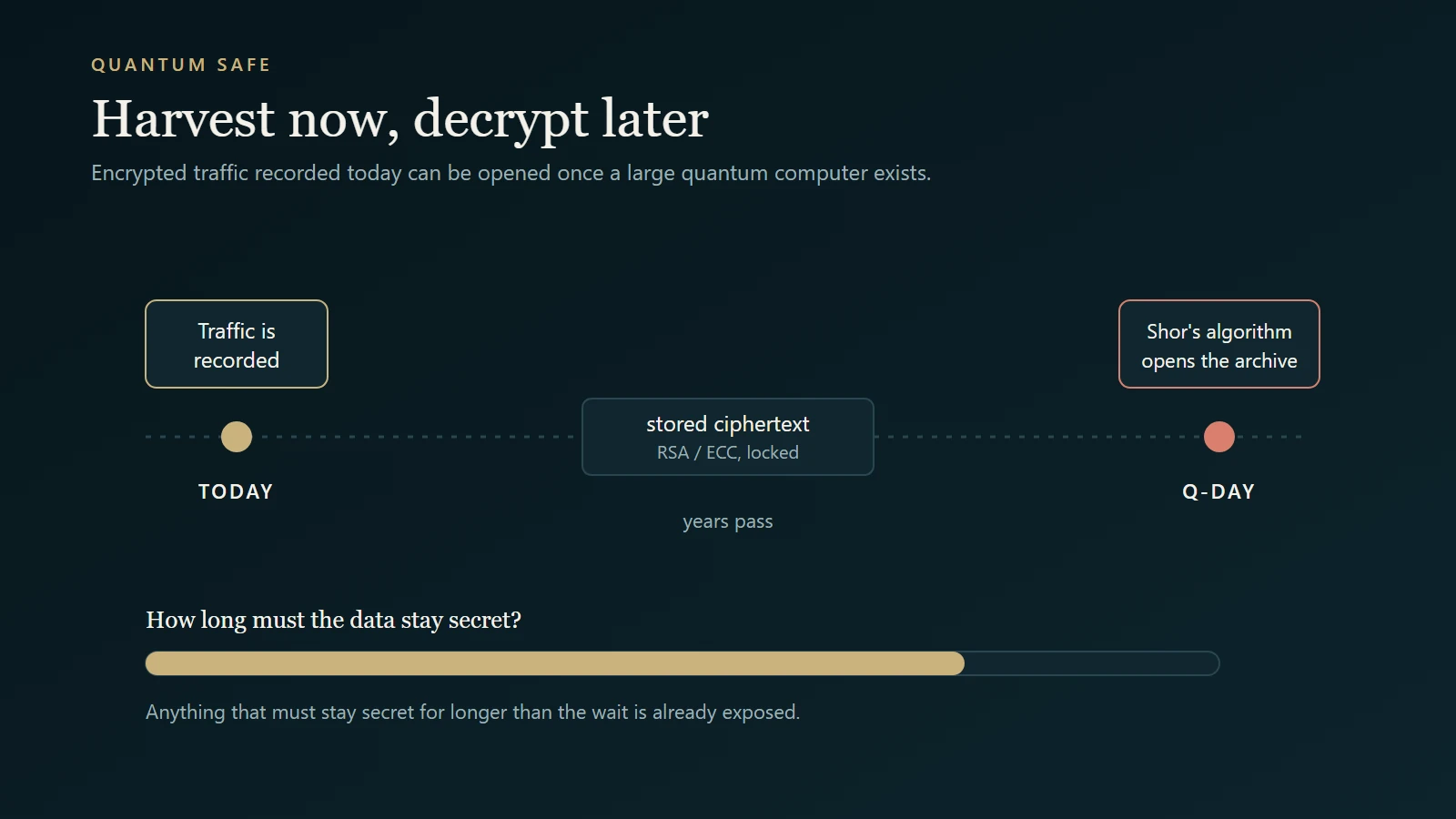
Recorded encrypted traffic can be stored today and opened later, once a large quantum computer exists. This is called harvest now, decrypt later. If the data has to stay secret for ten years, the clock started when it was sent.
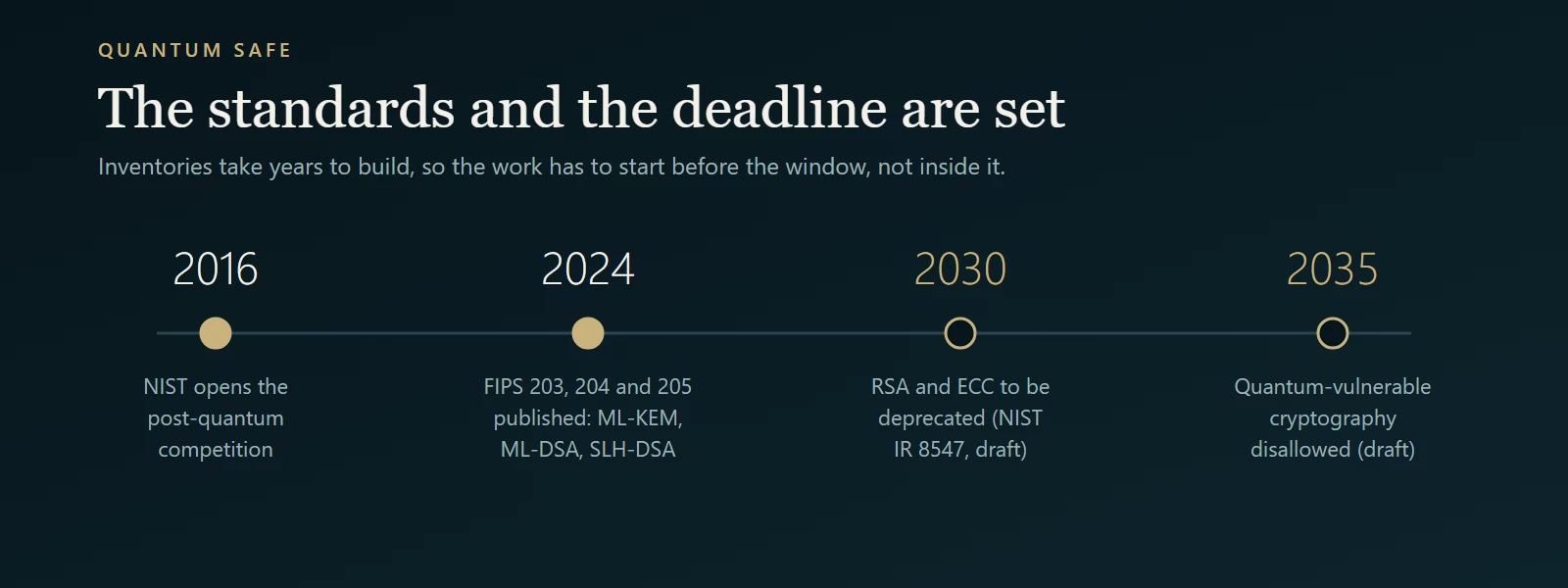
NIST published the first post-quantum standards (FIPS 203, 204 and 205) in August 2024, and its draft transition guidance (NIST IR 8547) proposes deprecating RSA and elliptic-curve cryptography by 2030 and disallowing it by 2035. Building a cryptographic inventory takes years, and few organisations know what breaks, or how much slower things get, when the algorithms change.
What we do
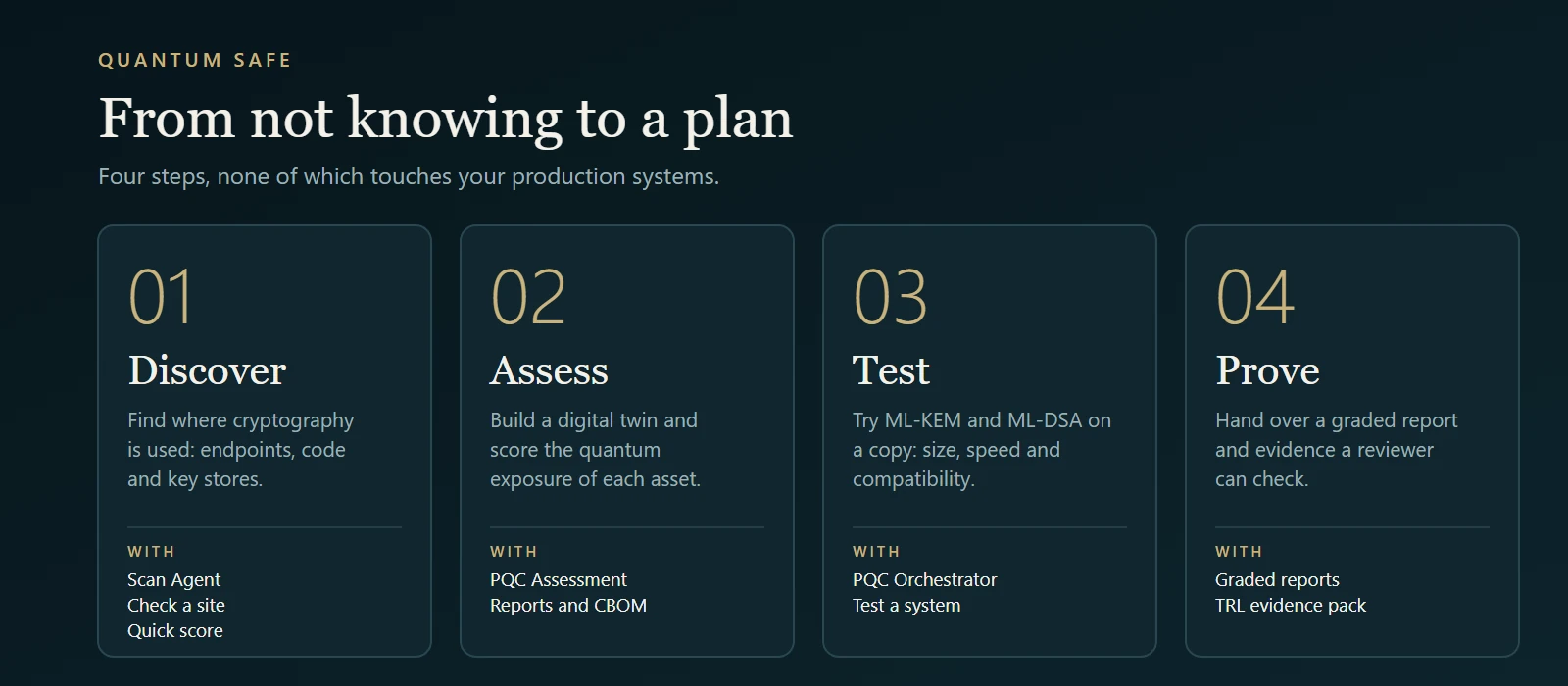
- Cryptographic discovery. Find where RSA, elliptic-curve and other quantum-vulnerable cryptography is used: network endpoints, source code and key stores. Read-only, and nothing leaves your network unless you send it.
- Quantum exposure assessment. Build a digital twin of the system you describe, score each asset for exposure, and rank what to replace first by how long the data must stay secret.
- Migration testing. Run ML-KEM and ML-DSA, and hybrid key exchange, side by side with what you use today. Measure handshake time, bytes on the wire, CPU and client compatibility.
- Evidence and roadmap. Deliver a graded report, a cryptographic bill of materials (CycloneDX CBOM) and a validation record, with every limit of the test stated.
What we built
| Part | What it does |
|---|---|
| PQC Assessment | Digital-twin assessment from sector templates (bank, hospital, utility, vehicles, software company and more): risk score, what breaks, migration plan. |
| Scan Agent | Read-only discovery of cryptography in endpoints, source code and key metadata. Redaction is on by default. |
| PQC Orchestrator | Recommends and runs standardised algorithms (ML-KEM, ML-DSA) with hybrid key exchange demos. |
| Test a system | Checks any TLS or SSH endpoint, in any cloud, for hybrid post-quantum support, gently and read-only. |
| Quick score | A free 20-question readiness score with a one-page report. |
| Validation suite | Four bank-system use cases tested in a lab, with known-answer tests, acceptance limits and recorded sign-offs. |
| Quantum Lab | Qiskit-based circuit editor and simulator for experiments. |
How an engagement runs
| Phase | What happens | You receive |
|---|---|---|
| 01 Discover | We scan the endpoints and code you choose, or take a CBOM you already have. | Inventory of cryptography in use |
| 02 Assess | We build the digital twin and score quantum exposure per asset. | Risk score and migration plan |
| 03 Test | We run the post-quantum options on a copy, in alternating pairs against today's setup. | Measured cost and compatibility |
| 04 Prove | We assemble the evidence, mark what is still open, and agree acceptance limits with you. | Report, CBOM and validation record |
Who it is for. Banks and payment providers, telecom operators, defence and aerospace programmes, medical-device makers and critical-infrastructure operators with long-lived data.
What you can expect from us.
- An assessment is built from your description, or from our read-only agent running inside your own network. Testing a live endpoint is a read-only handshake, only on systems you name and are allowed to test, with no logins and no load test.
- Results are labelled for what they are. Laboratory results are not presented as production results, and noisy measurements are called inconclusive rather than rounded into a number.
- The post-quantum code we use is open-source and is not FIPS 140-3 validated, so results show feasibility and cost, not regulatory compliance.
Four use cases, tested in the lab
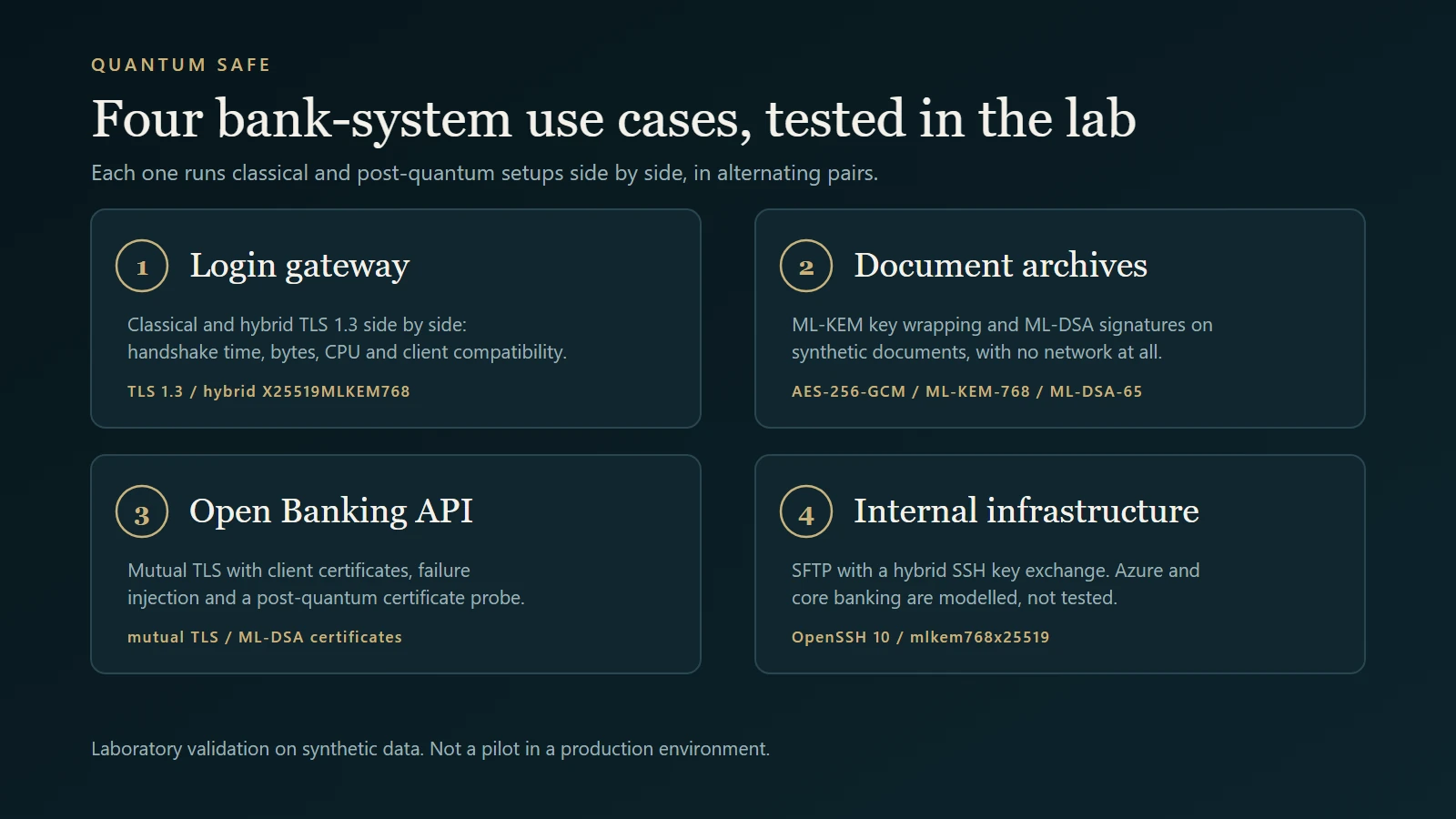
- Login gateway. Classical and hybrid TLS 1.3 side by side on an nginx gateway: handshake time, bytes, CPU and client compatibility.
- Document archives. ML-KEM key wrapping and ML-DSA signatures around AES-256-GCM on synthetic documents, in a container with no network.
- Open Banking API. Mutual TLS with client certificates, failure injection (expired, untrusted, missing and deep-chain certificates, fragmented handshakes, stalled clients) and a post-quantum certificate probe.
- Internal infrastructure. SFTP over OpenSSH with a hybrid key exchange. Azure services and core banking systems are modelled, not tested.
What we measured
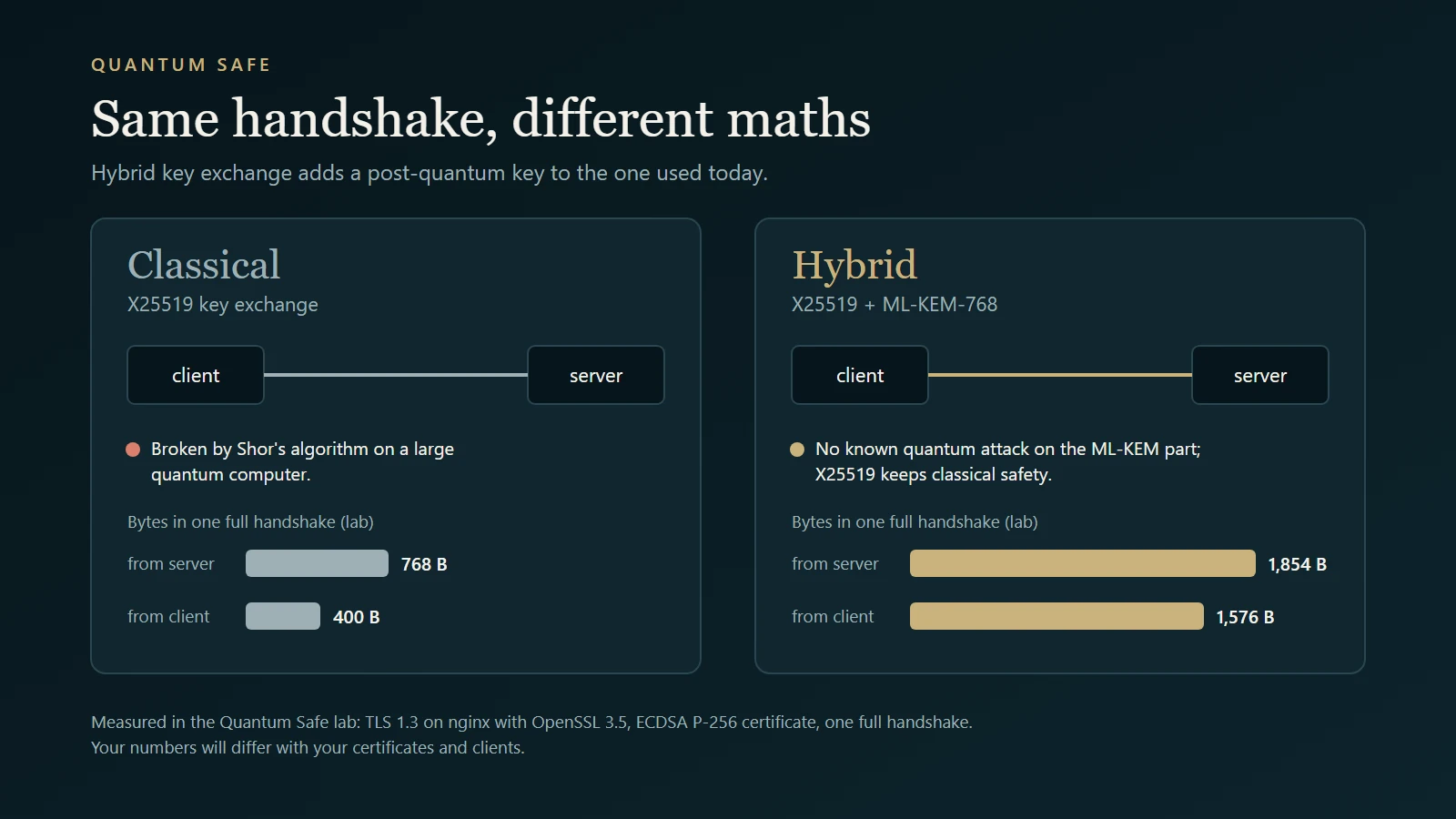
In our lab: TLS 1.3, nginx, OpenSSL 3.5, an ECDSA P-256 certificate, one full handshake.
- A hybrid X25519 + ML-KEM-768 handshake sent about 1.2 KB more from the client and 1.1 KB more from the server than classical X25519 (1,576 B and 1,854 B against 400 B and 768 B).
- Archiving a document with ML-KEM and ML-DSA added about 4 KB to the stored package, compared with classical key wrapping and signing.
- The post-quantum library passed 65 of 65 NIST known-answer test vectors (ML-KEM-768 and ML-DSA-65, FIPS 203 and 204).
- Handshake time differences were small but varied between runs on shared hardware. We report them as paired medians and mark results that are too noisy as inconclusive.
Where it stands
Technology readiness: TRL4 (validated in a laboratory) for the four use cases. TRL5 needs two things a test cannot decide: someone who owns the real system accepting that the lab environment is relevant, and cost limits agreed in advance. The platform records both as sign-offs.
Limits, stated plainly
- Laboratory validation on synthetic data, not a pilot in a production environment.
- No hardware security module or cloud key-management service was involved, so key custody is not tested.
- Real browsers, mobile clients, firewalls and load balancers were not in the path.
- We make no claim about any specific payment provider's API, Azure services or a core banking system.
- The post-quantum code is open-source and not FIPS 140-3 validated, so results show feasibility and cost, not regulatory compliance.
Technology
Python and FastAPI services, Next.js front end, liboqs and OpenSSL 3.5 for post-quantum algorithms, nginx and OpenSSH test rigs, Docker, Qiskit Aer for the Quantum Lab, CycloneDX for the bill of materials.
Questions
What is post-quantum cryptography?
Encryption and signature algorithms designed to resist attacks from both classical and quantum computers. NIST standardised the first ones, ML-KEM, ML-DSA and SLH-DSA, in August 2024.
Why act now if quantum computers are not here yet?
Because data recorded today can be decrypted later. If it must stay secret for ten years, the clock started when it was sent.
Do you need access to our production systems?
Not for an assessment. You describe your system and we build a digital twin, or you run our read-only scan agent inside your own network and decide what to send us. If you want a live endpoint checked, that is a read-only handshake on a system you name, with no logins and no load test.
What is hybrid key exchange?
It combines today's X25519 with ML-KEM, so a connection stays safe if either one is later broken. It is the usual first step in a migration.
Will it slow our systems down?
It makes handshakes larger, by roughly 2 KB in our lab, and sometimes slower. How much that matters for you depends on your traffic and hardware, which is exactly what the test measures.
Is it certified?
No. The post-quantum code we use is not FIPS 140-3 validated. Our results show feasibility and cost, not regulatory compliance.
Next
We are looking for pilot partners in financial services, telecom and critical infrastructure who can provide a representative environment. Talk to us about a quantum-safe migration.
